Agave
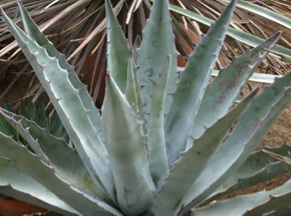
Historically in Mexico Tequila was traditionally made from
as many as 11 or more different Agaves, not just one as it is now. The Blue Agave, Agave angustifolia ssp.
Tequilana weber azul is the only legally permitted Agave to be used in the
production of Tequila. Restricting
Tequila production to this one clone, albeit an excellent one, has created an
extreme monoculture with much reduced genetic diversity and attendant problems
like less adaptability to different soils, altitudes, minimum temperatures,
total heat and total rainfall, making the plantings more susceptible to pests
and diseases which are then difficult to stop or control
Mescal and other regional distilled Agave spirits in Mexico, like Raicilla and Bacanora are made from other Agave species, sometimes more than one, often collected from the wild. For me the lesson is that a distinctive world class distilled Agave spirit can be made from a variety of Agave species, not just one! This is very important because here in California where we can grow whatever Agave variety we want but cannot call our distilled product either Tequila or Mescal because those names are protected by international law. We can still grow Agaves to produce a world-class spirit with an adaptive mix of species suitable to the individual property where the plants will grow. We can analyze a site’s ecological parameters and select a combination of Agaves that are adapted for that site’s soils and climate regime. Why a combination? To create diversity. To create balance. To create levels of adaptability and resistance. And yes! We do have and will incorporate Agave tequilana, Blue Agave, into the mix where minimum temperatures permit. In years of low rainfall irrigation will be necessary for that clone but in normal rainfall years a few summer irrigations will support plant development and a normal maturity cycle. The Agaves we offer are well adapted to a wide range of California conditions. Many of these have been grown in California for a hundred years or more. They have been grown as ornamentals and their commercial or economic value has been largely ignored. Modern day horticulturists decry the rampant vigor of these Agave species because they overwhelm the residential garden with their size and fecundity. This amazing vigor and vitality is exactly what the sustainable farmer of today needs to cost effectively produce a viable crop on challenging land with limited water. Context is everything. For a listing of the Agave species and subspecies that we grow please see our Agave availability page. For a discussion of the processing technology involved in crating a distilled spirit from Agaves or to learn about other uses and products derived from Agaves please see products and processing. |
Opuntia
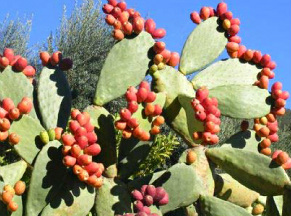 Tuna cactus or Prickly Pear cactus from
the genus Opuntia (O. ficus-indica) have a mixed reputation. In times past in some environments such as Australia and South Africa they were considered a scourge, an invasive exotic. Here in modern day California we need not fear or doubt the vigor and promise of the Tuna cactus. It is perfectly adapted to many California microclimates and presents itself as a valuable and manageable crop for this state. Our focus at Drylands Farming Company is the juicy, highly colored fruit the plants produce although others might be equally keen on the young, immature new pads called nopales, which are delicious, nutritious and medicinal (healing) food. The prickly pear fruit is revered in its homeland, Mexico, but is now highly esteemed in most of the known world. The Spaniards initiated its spread through Europe and Central and South America during their colonizing period and temporary conquest of Mexico. Not only is this fruit highly colorful, aromatic and sweet, it is very healthful – it is full of antioxidants, anti-inflammatory and beneficial in balancing blood sugar, and is also purported to be hangover prevention and cure. There is abundant information online regarding the health benefits and uses of the Prickly Pear. The Opuntia provides an added benefit to the landowner as wildfire protection used in what we call “firescaping” a property. The Prickly Pear Cactus is virtually a standing wall of water or gel. The Opuntia provides no fuel and additionally when planted in a hedgerow creates a fire barrier. The Opuntias we offer are time proven performers here in California having survived and thrived along fence lines, roadsides and other forgotten or neglected places for fifty to a hundred years or more. They have remained healthy and productive on native rainfall alone with no care or maintenance. Growing these plants in a commercial or farm setting is not the difficult part of this crop. It is the harvesting and marketing of the crop that demands work, creativity and some technology. This is largely due to the spines and small hair like stickers known as glochids on the skin of the fruit that require care in harvesting and handling and ideally equipment to brush and wash the spines from the fruit depending on how the fruit will be used. These issues and processes are discussed further on the page devoted to PRODUCTS AND PROCESSING. For a listing of the Opuntia cultivars now available for mail order please see our OPUNTIA AVAILABILITY page. Here you will also find a list of other varieties we have but are presently reserving for farm operations only. |
Vetiver
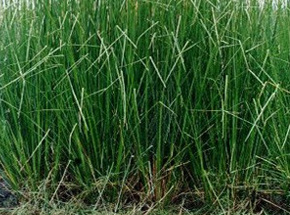 Much of the plantable acreage available
in Southern California and elsewhere for dryland crops is on moderately sloping to steeply sloping land where erosion and slope stability are important concerns. Vetiver grass is an amazing resource for farmers growing crops on slopes because of its unique characteristics, which make cost effective erosion control and slope stability possible. Vetiver grass is a perennial clumping grass with deep penetrating roots that hold soil below ground and strong dense stems above ground that capture sediment and keep soil on site. It can be established by planting bareroot slips or rooted container grown plants. In California, bareroot slips can be planted from late winter to early fall. Container plants can be planted year round. Vetiver grows rapidly and can provide protection after only one growing season Vetiver is ideally suited for crop plants planted in rows on the contour of a slope because it is best planted in a hedge along a contour to both capture runoff and provide strong rooting anchorage against slipping. Planted in between crop plants it provides protection without competing with the adjacent crop plants due to Vetiver’s vertical root architecture. In fact the Vetiver grass roots both provides a rich rhizophere with enhanced nutrient availability for the neighboring plants and traps subsurface water on the uphill side of the Vetiver hedge, which increases the availability of water to the crop plants. Creating natural terraces for crop the Vetiver hedge also functions as a nurse crop on difficult sites by providing protection from extreme sun and wind. For more information about vetiver grass go to http://www.vetiver.org/ |